Salivary Gland Neoplasms · Volume V of 5
Adjuvant Therapy, Recurrent Disease, and Surveillance
Convert final pathology and operative anatomy into an adjuvant, recurrence, surveillance, and survivorship plan that accounts for failure pattern, resectability, and molecular targets.
Orientation
About this volume
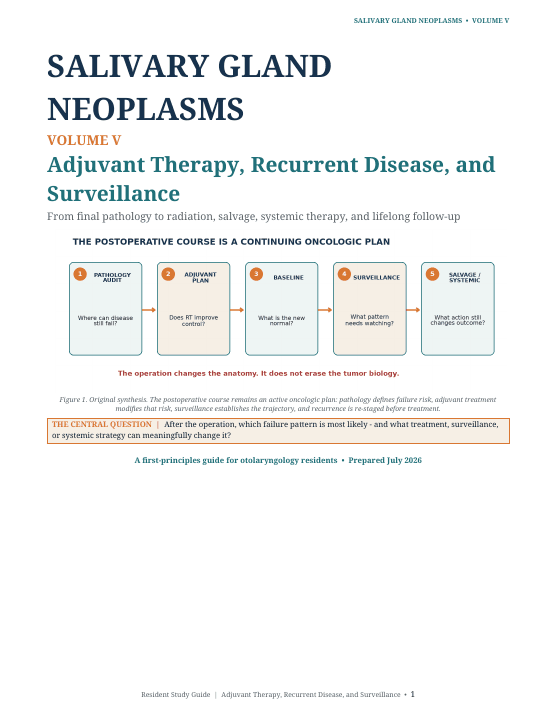
Volume V closes the salivary series by turning final pathology and altered postoperative anatomy into a long-term oncologic plan. It frames adverse features as a failure map for the local bed, named nerve pathways, nodes, distant disease, and actionable biology, then applies that map to postoperative radiation, target design, unresectable disease, locoregional recurrence, metastases, systemic options, and surveillance. Residents learn why chemotherapy is not routinely added to radiation outside a trial, when re-resection, reirradiation, observation, ablation, targeted therapy, or a trial may fit the clinical situation, and how AR, HER2, and NTRK results can matter in advanced disease. The final framework also includes function and survivorship. After Volume IV’s operation, this volume answers how treatment decisions and follow-up continue over the disease’s particular biologic time horizon.
After completing this volume, the resident should be able to
- Translate adverse pathology and postoperative anatomy into a local, neural, nodal, distant, and biologic failure map.
- Explain when postoperative radiation, re-resection, reirradiation, observation, ablation, targeted therapy, or trials may be considered.
- Design surveillance and survivorship priorities that reflect salivary histology and its time horizon.
Reader
PDF preview
Preview before loading
The full PDF is loaded only when requested to keep this page fast, especially on mobile.