Salivary Gland Neoplasms · Volume II of 5
Benign and Borderline Neoplasms
Use architecture, clinical setting, and natural history to distinguish benign and borderline salivary tumors, judge diagnostic confidence, and choose observation or appropriately planned surgery.
Orientation
About this volume
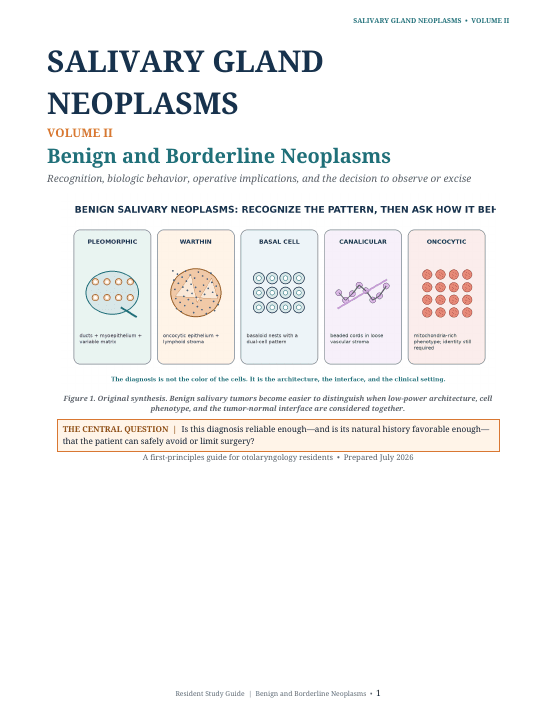
Volume II focuses on benign and borderline salivary neoplasms without treating “benign” as a promise of easy diagnosis or surgery. It builds a pattern language from low-power architecture, cell phenotype, tumor interface, and clinical setting, then applies it to pleomorphic adenoma, Warthin tumor, basaloid adenomas, myoepithelioma, oncocytic lesions, and selected newer entities and mimics. Residents learn why capsular violation changes the future problem in pleomorphic adenoma, when a concordant Warthin tumor may be observed, and why invasion rather than cytologic blandness separates important mimics. Management chapters connect diagnostic confidence, anatomy, natural history, surgical morbidity, and patient preference. Following Volume I’s workup, this volume clarifies when limited surgery or observation is defensible before Volume III addresses malignant biology.
After completing this volume, the resident should be able to
- Use architecture, cell phenotype, interface, and clinical setting to organize a benign salivary differential.
- Explain how pleomorphic adenoma, Warthin tumor, and important mimics differ in natural history and management.
- Balance diagnostic confidence, anatomy, morbidity, and patient preference when considering observation or surgery.
Reader
PDF preview
Preview before loading
The full PDF is loaded only when requested to keep this page fast, especially on mobile.