Salivary Gland Neoplasms · Volume I of 5
Foundations and Diagnostic Approach
Build a management-focused diagnostic plan for salivary-region masses using localization, behavior, imaging, tissue sampling, Milan categories, pathology, staging, and clinical discordance.
Orientation
About this volume
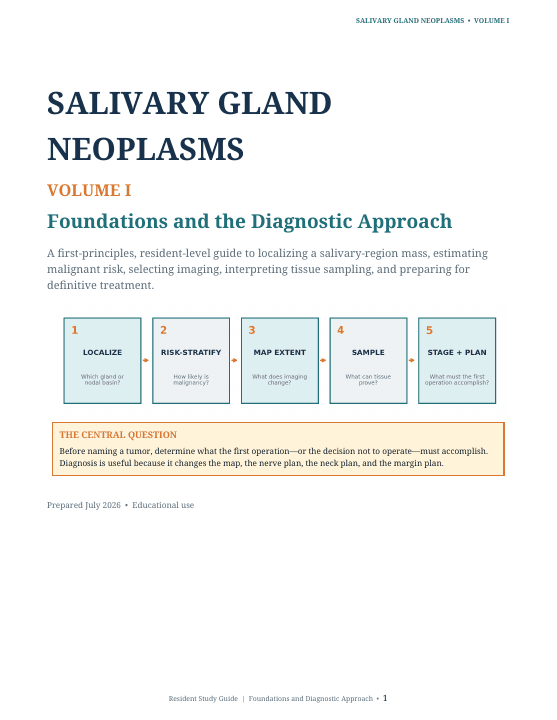
Volume I opens the salivary series with the problem a resident first encounters: an undifferentiated salivary-region mass. It uses a management-centered sequence—clinical behavior, anatomic localization, imaging, and tissue sampling—to decide what the first operation, or decision not to operate, must accomplish. Residents learn the triple test; parotid, submandibular, sublingual, minor-gland, nodal, and nonsalivary compartments; modality selection; FNA and core biopsy limits; Milan System risk categories; modern pathology; and AJCC Version 9 orientation. Integrated cases highlight discordance, such as a reassuring sample that does not fit facial weakness or imaging. Unlike later volumes on specific histology, surgery, or surveillance, this foundation teaches how to map risk and avoid an inadequately planned first treatment.
After completing this volume, the resident should be able to
- Localize a salivary-region mass and integrate clinical behavior, imaging, and tissue sampling as a triple test.
- Interpret FNA, core biopsy, Milan categories, pathology, and staging in their management context.
- Recognize diagnostic discordance that should change the planned first treatment.
Reader
PDF preview
Preview before loading
The full PDF is loaded only when requested to keep this page fast, especially on mobile.