Salivary Gland Neoplasms · Volume III of 5
Malignant Neoplasms
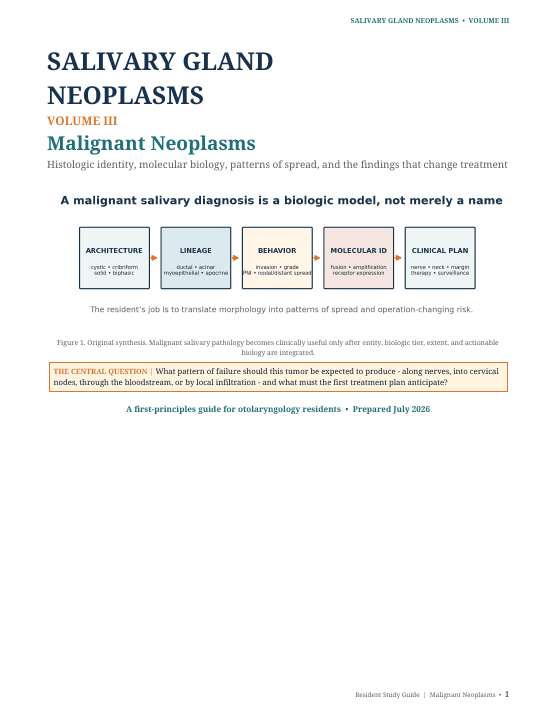
Interpret malignant salivary pathology through tumor identity, grade, extent, spread pattern, and actionable biology to anticipate the nerve, neck, margin, and treatment implications.
Orientation
About this volume
Volume III organizes malignant salivary tumors as biologic families rather than an alphabetical list of rare diagnoses. It teaches residents to read a pathology report in four coordinates: entity, tumor-specific grade or biologic tier, anatomic extent, and actionable biology. Chapters compare the defining patterns and clinical consequences of mucoepidermoid, adenoid cystic, acinic cell, secretory, salivary duct, carcinoma ex pleomorphic adenoma, polymorphous, biphasic, and myoepithelial carcinomas, along with difficult mimics and high-grade transformation. Cases show how perineural behavior, nodal risk, metastatic tempo, or a molecular finding changes preoperative planning. This is the series’ biology-and-risk volume, positioned between Volume II’s benign differential and Volume IV’s operation planning; it explains what the diagnosis should predict before the patient reaches the operating room or tumor board.
After completing this volume, the resident should be able to
- Read malignant salivary pathology by entity, tumor-specific grade, anatomic extent, and actionable biology.
- Connect perineural behavior, nodal risk, metastatic tempo, and molecular findings to clinical planning.
- Differentiate major malignant families and difficult mimics by the consequences their diagnosis should predict.
Reader
PDF preview
Preview before loading
The full PDF is loaded only when requested to keep this page fast, especially on mobile.