Free-Flap Reconstruction · Volume III of 5
Reconstruction by Defect
Apply defect-first reasoning to oral cavity, mandible, maxilla, pharynx, skin, and skull base, matching residual function and failure modes to a defensible construct.
Orientation
About this volume
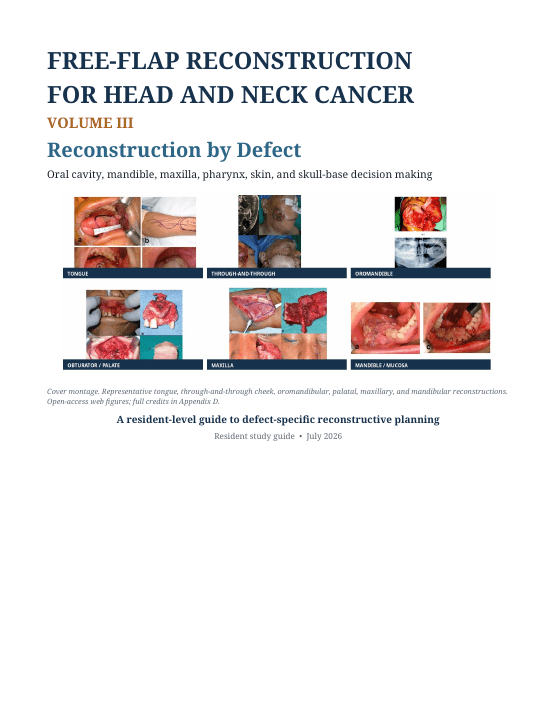
Volume III brings the earlier defect audit and donor-site toolkit together at the level of the actual resection. It organizes planning around oral cavity, tongue, cheek, palate, mandible, maxilla, pharynx, scalp, temporal bone, orbit, and skull base defects, asking what native function remains and what failure matters most. Residents work through mobility versus bulk, layered surfaces, dental and orbital support, barrier construction, dead space, and conduit geometry before choosing a flap. Integrated cases model how to state the defect, tissue requirements, primary construct, and backup rather than recite a preferred flap. It is the series’ construct-selection volume: Volume II explains available tissue, whereas Volume IV addresses the operative execution once the reconstructive plan is chosen.
After completing this volume, the resident should be able to
- Identify the functional priorities and dominant failure modes of common head and neck defects.
- Build a tissue-and-geometry specification before selecting a reconstructive construct.
- Defend a primary and backup construct for oral cavity, bony, pharyngeal, skin, or skull-base defects.
Reader
PDF preview
Preview before loading
The full PDF is loaded only when requested to keep this page fast, especially on mobile.