Free-Flap Reconstruction · Volume IV of 5
Building the Reconstruction
Follow a free-flap plan through the operating room: contingencies, two-team workflow, recipient vessels, microvascular logic, inset, pedicle protection, and physiology-guided perioperative execution.
Orientation
About this volume
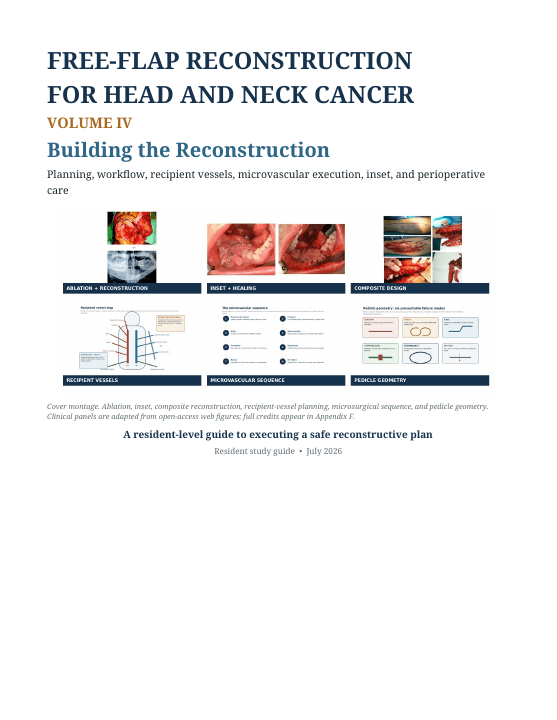
Volume IV follows a chosen reconstructive construct through the operating room. Its central idea is that a free-flap operation succeeds when planning, ablation, harvest, recipient vessels, microvascular work, inset, airway, and physiology remain aligned—not when an anastomosis is merely patent. Residents learn to define intraoperative branch points, coordinate a two-team case, assess recipient arteries and veins, understand end-to-end and end-to-side logic, manage size mismatch and venous coupling, and protect the pedicle during routing, closure, drains, and positioning. It also links fluids, vasopressors, temperature, transfusion, nutrition, and handoff to flap safety. This is the execution stage after Volumes I–III; postoperative monitoring, salvage, and rehabilitation begin in Volume V.
After completing this volume, the resident should be able to
- Anticipate branch points and coordinate the reconstructive sequence within a two-team operation.
- Explain recipient-vessel, anastomotic, inset, and pedicle-routing decisions in practical terms.
- Connect perioperative physiology, airway planning, drains, positioning, and handoff to flap safety.
Reader
PDF preview
Preview before loading
The full PDF is loaded only when requested to keep this page fast, especially on mobile.