Facial Trauma · Volume VI of 6
Rebuilding the Facial Coordinate System
Plan panfacial reconstruction by identifying trustworthy references, restoring coupled facial dimensions, sequencing fixation, verifying geometry independently, and analyzing early or late failure.
Orientation
About this volume
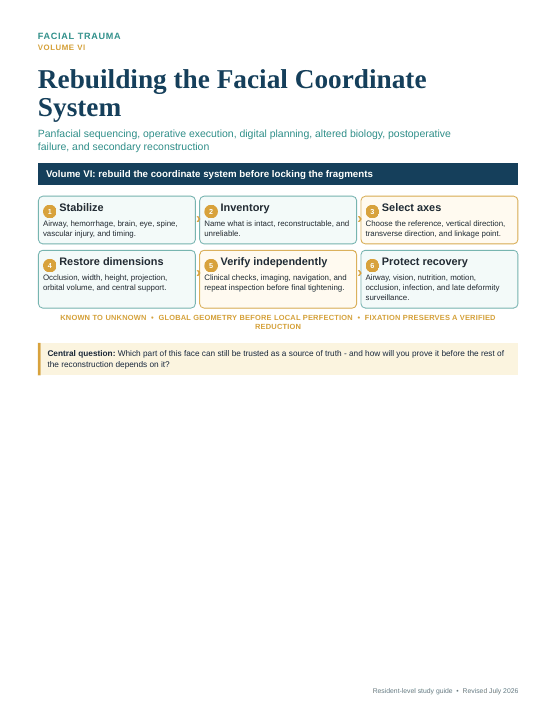
Volume VI is the Facial Trauma series capstone, for situations in which several reference systems are displaced and a locally accurate reduction can still create a globally wrong face. It frames panfacial repair as restoration of a coordinate system: decide what is intact, reconstructable, or unreliable; choose vertical and transverse axes with a linkage point; restore occlusion, width, height, projection, orbital volume, and central support; then verify independently before definitive fixation. Operative planning, digital tools, altered biology, postoperative failure, complications, and secondary reconstruction extend the regional principles from the earlier volumes. Residents gain a way to reason through sequencing rather than memorize a universal order. It completes the progression from emergency recognition to regional reconstruction and integrated whole-face recovery.
After completing this volume, the resident should be able to
- Classify cranial, orbital, occlusal, and soft-tissue references as intact, reconstructable, or unreliable.
- Choose a sequencing axis, linkage point, and independent verification method before definitive panfacial fixation.
- Analyze postoperative and secondary deformity as failures of geometry, biology, stability, soft tissue, or function.
Reader
PDF preview
Preview before loading
The full PDF is loaded only when requested to keep this page fast, especially on mobile.